|
|
|
|
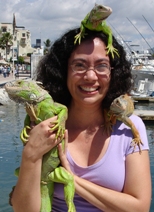
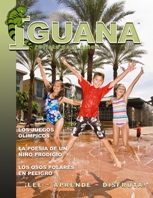
We are delighted to have Christianne Jacobs with us this month to share some information about the Spanish language children's
magazine Iguana. Thank you, Christianne, and welcome!
• Can you share a little about yourself, Christianne? How and why did you begin Iguana?
I was born in Nicaragua, in Central America, and, as a native Spanish speaker, I believe it is
important that my daughters grow up in a bilingual/bicultural environment. The lack of quality,
original Spanish language children’s stories and poems led me to create Iguana, the Spanish language
magazine for children. I was an elementary school teacher with an assortment of journalism experience.
My husband is a graphic artist and designer. Combining our talents we funded and launched Iguana
in 2005. Recently, Iguana was acquired by ePals Inc., the parent company to respected,
award-winning children’s magazine publisher Cricket and Cobblestone Children Magazine Group.
• What’s your favorite part of your job?
My favorite part is crafting every issue of Iguana from cover to cover. I spend many hours
thinking, researching and creating engaging Spanish language content for Latino kids born in the
United States, as well as for children (and adults) who are learning Spanish.
• For those who might not be familiar with Iguana, please tell us a little about it. What
sets it apart as a magazine?
Iguana is unlike anything currently in the market. Native speakers write original content in
Spanish. It contains a variety of fiction and non-fiction stories, poems, science, history,
interviews, and much more. Iguana’s goal is to serve as a tool for Spanish language retention
and Latino cultural preservation.
• What do you particularly look for in a submission? What gets you excited?
I look for themes, ideas and topics that are different from what children learn in school. We like to
publish articles and stories that are different from a textbook piece and plant the seed of curiosity
in children. I am excited when I read a story that our readers can identify with because of their
immigrant experience or specific background.
• What things turn you off to a submission? Any pet peeves?
We like our stories to be written originally in Spanish. But the stories also have to make sense, with
a clear beginning, middle and end that our readers can understand and enjoy. Major turn-offs include
fiction stories that are translated, as well as bad punctuation, misspellings, and lack of proof
reading. My pet peeve is asking a writer to re-write a piece and later receiving the same submission
with no changes.
• Your submission guidelines say, “all submissions must be originally written in Spanish.” So I
assume that if an author wrote a story or article and had a native Spanish speaker translate it into
Spanish that would not be acceptable. Can you please share with us why that would be true?
The Spanish language has its own rhythm and phrasing. Translations lack originality and it is difficult
to adapt the language to match the feel of the original. We do not accept translations! However, our
“Children Around the World” section features children from other countries, their lives in their
native land and the similarities/differences they have with children in the United States. Sometimes
there are difficulties finding a native Spanish speaker who can write the article, wherein I make an
exception and accept an English-language story, which we translate to Spanish. We are always
interested in receiving stories for that section from far-flung locations. We also accept creative,
original craft projects in English, which we also translate.
• Any tips for photographers or illustrators who want to be published in Iguana? Should
they just send interesting pictures and hope you want to use them? Or do you keep samples on file and
make assignments to go with upcoming stories and articles?
The freelance photographers and illustrators do not need to be native Spanish speakers. We have
illustrators all over the world that submit digital files of their art work. As an introduction, I ask
artists to email me low-resolution files of their artwork or a link to a website so my art director
and I can evaluate their style. We do not accept unsolicited pictures or illustrations. My art director
and I assign illustrations so that they match well with what we publish in a given issue.
• Do you have suggestions for writers who want to submit puzzles, games, recipes, or crafts? You
told me your art director usually creates your games and puzzles, so do those submissions have a small
chance of getting published?
I would prefer submissions for the craft sections. Those are harder to find. As I mentioned, the craft
projects can be submitted in English and then they will be translated to Spanish to be published in the
magazine. I might take a look at an interesting recipe that is culturally sensitive but that is
written in English.
• Do you have any other information about Iguana you'd like to share with us?
I encourage writers to visit www.IGUANAmagazine.com
for submission guidelines and to write to me directly at revista_infantil(at)yahoo(dot)com. I also
invite everyone to visit www.cricketmag.com/iguana
for more information about Iguana and to take a look at a sample of Iguana.
Thank you so much, Christianne, for taking the time to share with us this helpful information
and for creating such a great magazine for Spanish speaking kids.
For you authors who are now inspired to write something for this unique publication, the submission guidelines
are
here.
Writing for Children's Magazines, May 2013
|
|
|
|
|